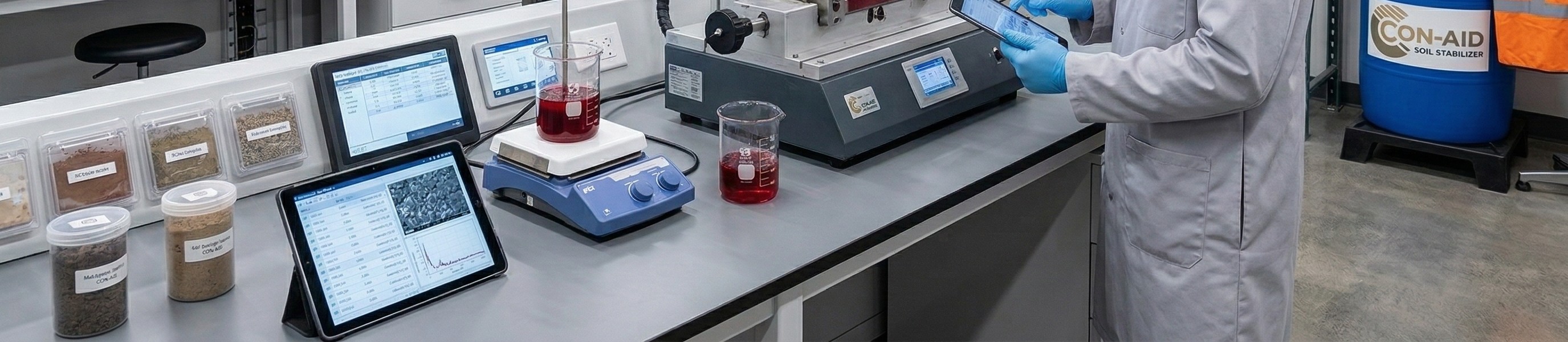
CON-AID / CBR PLUS is an ionic soil stabilizer that improves the load-bearing capacity of clay and silty soils by altering their water interactions microscopically. The product permanently bonds to soil and clay particles, forming a protective layer that:
"The result is a stabilized road layer that is far less sensitive to moisture, easier to work with, and able to withstand traffic loads over time."
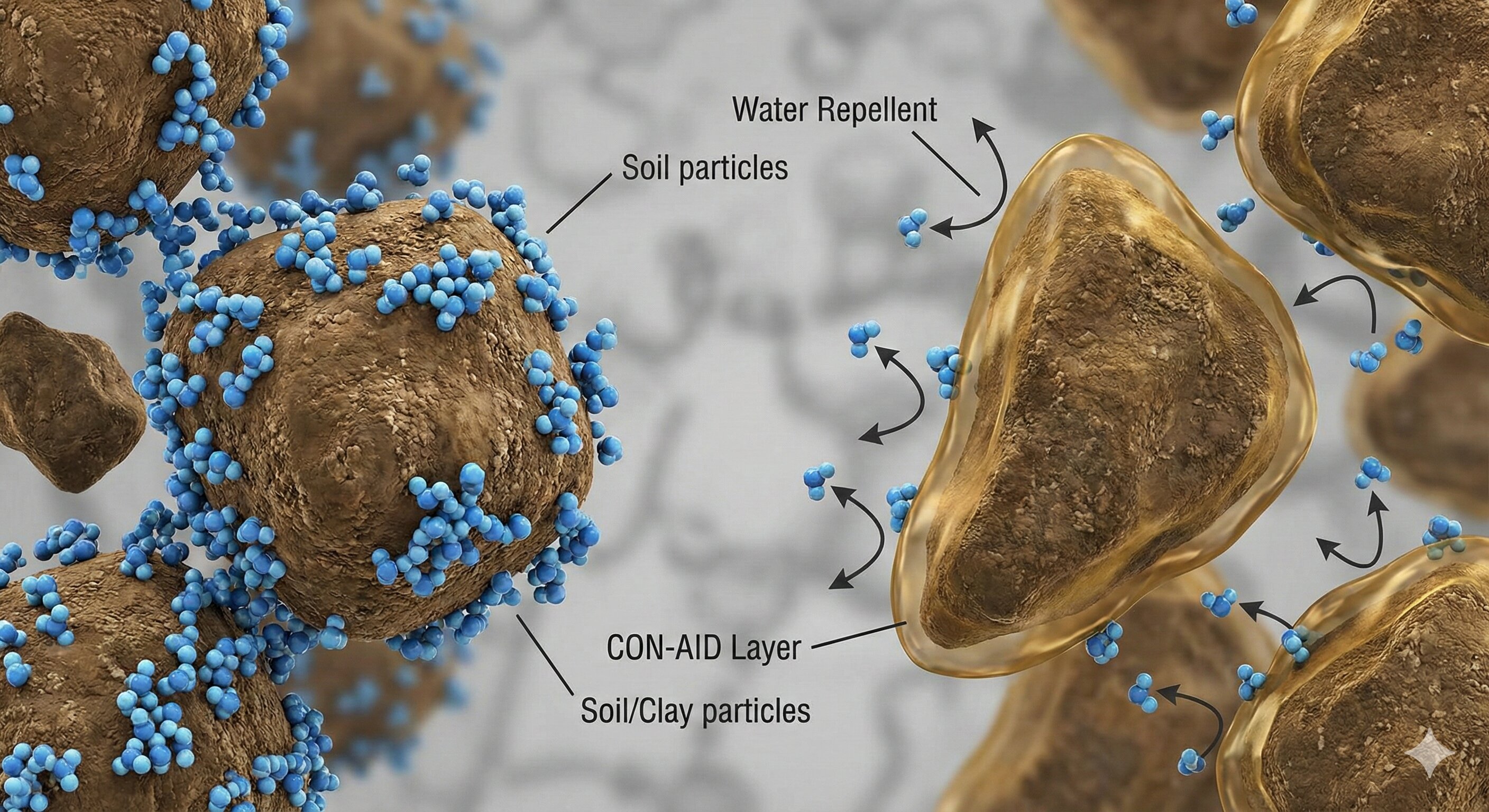
CON-AID / CBR PLUS is a cation reactive thio compound which forms protective layers on the surfaces of the soil and clay particles. It reduces ion mobility and ion exchange and simultaneously makes the material hydrophobic by eliminating the adsorption of water.
The result is a soil material that is much less sensitive to moisture, more workable and can be compacted to a better particle-interlock state by equipment and traffic forces.
Better particle interlock means higher internal friction and improved bearing capacity. It also means greater density and less penetration of water. The active reagent is permanently bonded to the clay surface.
CON-AID / CBR PLUS will treat a wide spectrum of materials ranging from clays to clayey silty sands and clayey gravels. The material must display some cohesive properties (i.e. contain clays). Non-cohesive materials such as sand can be treated only after they have been modified by mixing them with a suitable clay material.
CON-AID / CBR PLUS has been in use worldwide for over forty years. Consistent quality batch control at the manufacturer, detailed soil analyses and professionally designed application rates and construction methods ensure successful results.
The Anionic Active Surface Agent Process
CON-AID / CBR PLUS was developed to enhance the release of adsorbed water from clay, to achieve maximum density, with less mechanical effort and to prevent the re-adsorption of water. This results in a permanently stabilized construction material.
Most clay minerals are made up of stacks of silica and alumina sheets. The arrangement of these sheets result in different clay minerals such as kaolinite, montmorillonite, and illite.
Simply stated, these clay minerals have a predominantly negative electrical or anionic charge. This causes the clay minerals to have a strong attraction for any cations that are present. The negative clay minerals attract cations like iron filings to a magnet and will react with water when present. This layer of water is known as the electrostatic diffused double layer or adsorbed water.
Further away from the clay particle, the water molecules are no longer attracted. This water is known as random water or absorbed water.
Certain clays, like montmorillonite, have spaces between their plates that can adsorb water causing them to expand. These are known as expansive or swelling clays and are the cause of many failures in foundations or road layers.
The obvious solution is to prevent the adsorption of water. If stronger positive molecules can be supplied, the negative charge of the clay minerals can be more than satisfied. This allows for displacement of the water under compaction and increase in density. This process continues over time to give high strength to the road. Therefore-ingress of water is prevented and a permanent road is provided.